


Historical Markers Near Baldwin Park
Imagining History in Blue and Gold: AI-Generated Pennsylvania Historical Markers for Baldwin Park.
Pennsylvania’s iconic blue-and-gold historical markers are a familiar presence across the commonwealth. First placed in 1914 and now administered by the Pennsylvania Historical and Museum Commission (PHMC), the program has grown to mark more than 2,000 sites across all 67 counties — moments, movements, and people that shaped the state and the nation. Today, nearly 2,600 cast aluminum markers commemorate subjects ranging from Native American history and early colonization to historic industries, commerce, and movements for freedom and equality.
Yet in Philadelphia’s Baldwin Park neighborhood — roughly bounded by Spring Garden Street to the north, Vine Street to the south, 16th Street to the east, and 21st Street to the west — formally recognized markers are surprisingly scarce. Within two blocks of Matthias Baldwin Park, only three state historical markers currently exist: one honoring Matthias Baldwin himself at the northwest corner of the park, one in front of the Parkway Central Library, and one at 1937 Callowhill Street commemorating a pioneer of helicopter flight.
Three markers for a neighborhood of this historical density seems woefully inadequate. Baldwin Park was the beating heart of Philadelphia’s industrial age. It was home to the Baldwin Locomotive Works — at its peak the largest employer in the Philadelphia region — along with machine shops, spring manufacturers, car wheel foundries, pharmaceutical pioneers, and the infrastructure of a growing industrial city. Generations of workers, inventors, and immigrants left their mark on these blocks.
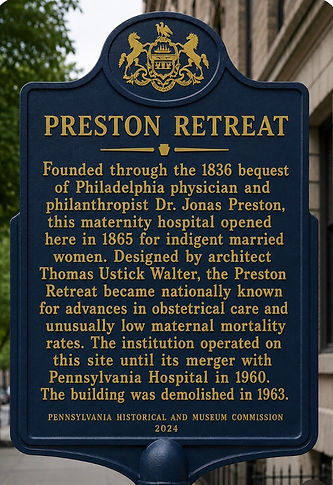
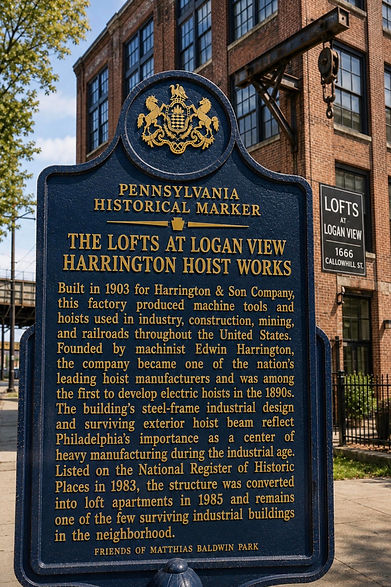
This pictorial feature imagines what might be. Using artificial intelligence, we have generated a series of hypothetical Pennsylvania state historical markers for sites and stories in Baldwin Park that, in a just world of unlimited nominations and budgets, would already bear the commonwealth’s seal. Consider these a wish list — and perhaps an invitation.
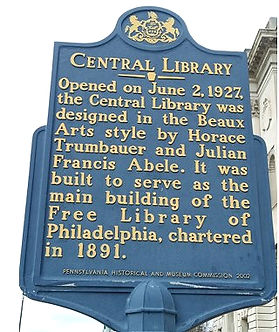


Photos from 2026 of the three real State historical markers in the neighborhood. They mark the Parkway Central Library, the first shop of Frank Piasecki at 1937 Callowhill Street, and of course the Baldwin Locomotive Works marker at the northwest corner of the Park. The text for this last sign was written by a Friends group founder, Sandy Owens, a human.
All text on this page that is not in italics is AI generated. The text not on the markers was written by Claude and the images of the markers including the text on the markers were generated by ChatGPT. This article is a personal experiment with AI-generated content as well as a shout out to the potential historical markers available in our neighborhood (though AI is more passionate about placing them than the owners of those sites would probably be).
How the Marker Text Was Written
The non-marker text in this article was composed by Claude, a large language model made by Anthropic. Generating it required neither magic nor deep archival instinct — just a particular kind of structured attention to sources that had already been assembled by human researchers.
A large language model is trained on vast quantities of text. In the process, it develops a facility with language patterns, genre conventions, and factual associations. It learns, among other things, what a Pennsylvania historical marker sounds like: the compressed syntax, the declarative confidence, the habit of anchoring a person or event to a specific address and date. Reproducing that register for a new subject is, for a model like ChatGPT, a relatively straightforward task — provided the underlying facts are accurate.
That proviso matters enormously. A language model will produce fluent, plausible-sounding text whether or not its factual foundations are solid. Left entirely to its own devices, it will sometimes confabulate — generating names, dates, and details that feel right but are not. For a project like this one, where the goal is to honor real history rather than invent it, that tendency has to be actively managed.
The method used here was simple: the model was supplied with verified source material drawn from the Friends of Matthias Baldwin Park website, primary documents, and other reliable local histories, then asked to draft text grounded strictly in those sources. The resulting drafts were reviewed for accuracy. Where the model reached beyond what the sources supported, it was corrected.
Think of it less as artificial intelligence conjuring history, and more as a very fast first draft — one that still depends entirely on the slow, careful work of human researchers who got there first.
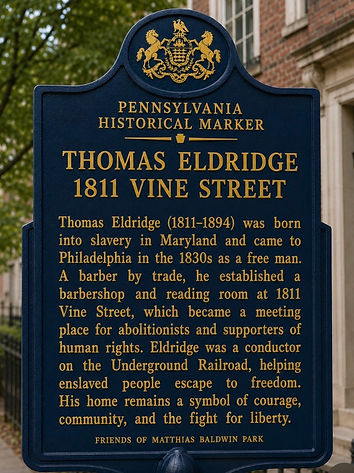

Confabulation on the left (top on phone) due to an unrestricted search. Correct text on the right when ChatGPT is directed to obtain information from the Friends of Matthias Baldwin Park website.
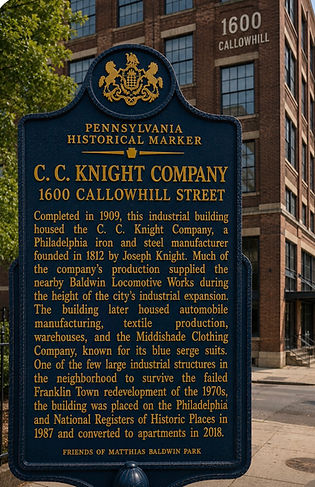


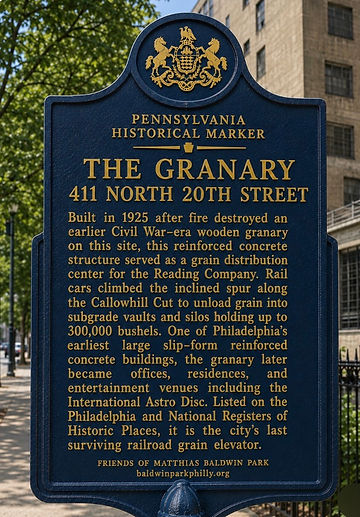




A Neighborhood Still Waiting to Be Read
The twenty markers imagined across these pages represent only a partial accounting. Every block in Baldwin Park carries layers that resist easy summary — a factory floor, a water main, a boarding house, a patent, a life. The sites pictured here were chosen because their stories are documented, their significance is demonstrable, and their absence from the official record is hard to explain. But for every marker shown, there are a half-dozen more that might have qualified.
That is not a criticism of the Pennsylvania Historical and Museum Commission, whose nomination process is rigorous precisely because it should be. The criteria for approval are demanding, and the program depends on nominations supported by serious historical research. The barrier is not indifference at the state level — it is the absence of organized, sustained advocacy at the neighborhood level. Markers do not appear because a place deserves them. They appear because someone does the work.
The Friends of Matthias Baldwin Park have been doing that work for years, recovering and publishing the history of this neighborhood building by building, block by block. The research exists. The stories are there. What these AI-generated images suggest is that the next step — formal nomination to the PHMC — is not as distant as it might seem. A neighborhood that produced locomotives for the world, shaped American industrial medicine, and housed the aspirations of successive immigrant communities has more than earned a place in Pennsylvania’s official memory.
Blue and gold markers weather well. They stand through development booms and downturns, outlasting the buildings they once described. Baldwin Park is changing rapidly. The moment to fix these stories in place — literally, on a post at a street corner — is not later. It is now.