


Philadelphia Tabernacle
1801 Spring Garden Street
There has been a church at the northwest corner of Spring Garden and 18th Streets since 1863. It is the oldest non-residential building in the Baldwin Park neighborhood and is a contributing building in the Spring Garden Historic District on the Philadelphia Register of Historic Places.
The history of the site of the church is quickly told, as the church building was constructed on bare land and has been minimally changed since 1863:
-
part of Coaquannock, the "grove of tall pines" settled by the Lenni Lenape;
-
acquired by William Penn in 1681 and eventually made part of his Springettsbury estate;
-
sectioned off to Andrew Hamilton by Hannah Callowhill Penn as payment for legal services and becoming the back yard of the Bush Hill Manor;
-
finally, one of the larger parcels when the Bush Hill estate was split up in 1813 at the death of William Hamilton.

Philadelphia Tabernacle at the northwest corner of 18th and Spring Garden Streets
The current structures along Spring Garden Street on either side of the church have been discussed elsewhere on our website. The Hoopes mansion across 18th Street is discussed here and the Carpenters Union building to the church's west here. The NxNW Apartments across Spring Garden Street to the south is discussed here and the Community College of Philadelphia is here.

Portion of an 1810 map showing the future location of the Fifth Baptist Church at the blue dot, northwest of the Bush Hill Mansion that faced Fairview Street (now Buttonwood) but backed up to what would become Morris Street (now Spring Garden Street). Bush Hill was still a large estate in 1810 but the mansion itself had been gutted by fire in 1808. Isaac Macauley purchased the manor house in 1818 for use as an oil cloth factory.
The dotted lines along the streets north of Callowhill Street represent planned streets that had not yet been developed.
The First Baptist Church was founded in Philadelphia in 1698 by members who had previously worshipped at the Pennepek Baptist Church, which was founded in 1688. Over the next one hundred years First Baptist moved around in Philadelphia in different buildings at varied sites. From 1782 to 1803 the pastor of First Baptist was Thomas Ustick. If that name sounds familiar, it is because architect Thomas Ustick Walter was named for him, as Walter's parents were members of the First Church. Thomas U. Walter designed the Preston Retreat; the first Wills Hospital and Girard College, both in our near neighborhood; and St. George's Hall at 13th and Arch Streets, headquarters of the Society of Saint George which moved to 1901 Spring Garden Street in 1922.
The most recent building for the First Baptist Church was built in 1900 at 17th and Sansom Streets and still exists, although it was sold to Liberti Church in 2014. The congregants of the First Baptist Church currently lease the building for their own services under a sharing agreement. For more First Baptist history see here.
In 1811 a contingent of 91 members seceded from the First Baptist Church and organized under Rev. William Staughton (1770-1829). They built a circular church 90 feet in diameter on the south side of Sansom Street between 8th and 9th Streets, with John Mills as architect, and called themselves the Sansom Street Church. Staughton served as pastor until 1823. When he left to head what is now George Washington University the attendance fell and the building was sold to John Welsh for $3,500 plus liens of $9,000 and reorganized as the Fifth Baptist Church.
Theology Tangent Time
Until recently most church histories were stories of schisms and branching, mother churches spawning daughter churches directly or by waving goodbye to congregants with unacceptable theological opinions. The story of the church at 18th and Spring Garden includes both these chapters. Since the Fifth Baptist Church had the longest tenure at 18th and Spring Garden, from 1863 to 1955, let's answer the question: what makes a Baptist a Baptist?
Like our well-known Philadelphia Quakers, the Baptist movement started in the early 1600s in England as a group of Separatists looked to reform Christianity. Like Quakers, the Baptists advocated for religious liberty and separation of church and state. Like most Protestant groups, Baptists believe in the divinity of Christ, salvation through faith, and the authority of the Scriptures. Distinctive Baptist beliefs include:
-
rejection of infant baptism and insistence on adult baptism only for believers who are old enough to make their own confession of faith;
-
baptism by full-body immersion;
-
recognition of the Bible as the final authority on beliefs and practices;
-
local church governance;
-
no priestly class, i.e. every Baptist has direct access to God through prayer.

Beloved pastor at the Sansom Street Church.
His second wife was Anna Claypoole Peale, niece of Charles Wilson Peale, and a noted miniaturist painter in her own right. They married in August 1829 and Staughton died in December 1829.
The Philadelphia Museum of Art has a portrait of Anna done by her cousin Rembrandt Peale, as well as a portrait of Staughton's son James Martin Staughton (1800-1833) done by Anna in 1829.
And a Peale Tangent:
Anna Claypoole Peale (1791-1878) is the third member of the Peale family tree that has been mentioned on our history pages. Anna was the daughter of James Peale (1749-1831), the brother of Charles Willson Peale (1741-1827). Sophonisba Peale (1786-1859), who married neighborhood machinist Coleman Sellers, was the daughter of Charles and his first wife Rachel Brewer (1744-1790). Benjamin Franklin Peale (1795-1870) was the son of Charles and his second wife Elizabeth De Peyster (1765-1804). Unlike the many portrait painters in his family, Franklin Peale, as he was known, was a machinist who was made Chief Coiner of the US Mint in 1839. He was also the person who convinced Matthias Baldwin to make first a child-size version of a locomotive and then the full-sized Old Ironsides, as discussed here.
Meanwhile, back to our story....

The Fifth Baptist Church is on the left edge of this image circa 1848. The annotation in the lower right marks the view as the SE Corner of George (now Sansom) and Ninth Street.

A photo from 1858 of the Fifth Baptist Church looking southeast over the foundation of the Continental Hotel under construction at Ninth and Chestnut. All these buildings are now gone. The Continental Hotel was where president-elect Abraham Lincoln gave a speech on February 21, 1861, commemorated by a plaque on the replacement hotel, the Benjamin Franklin Hotel, which opened in 1925 and is now the Franklin Residences. Two names with neighborhood ties are involved with the Ben Franklin Hotel: Horace Trumbauer was the architect in 1925 and the Korman Corporation took it residential in 2011. Photo from here.

A lithograph of the Baptist Church circa 1850 from here. A baptism is about to take place with a crowd that suggests a bigger church is in order.

Portion of an 1862 City atlas showing the round Fifth Baptist Church (the Sansom Street Church) just west of the circus and east of the round bazaar building at the southeast corner of 9th and Sansom Streets.
The church grew in popularity necessitating a move to the current building at the northwest corner of 18th and Spring Garden Streets. It was designed in the Gothic style by architect Alfred Biles and opened for worship on February 7, 1863. This was Biles' first and last commission, as he was killed in the Civil War while the church was still under construction.
The decade of the 1860s saw new near-neighborhood churches besides at 18th and Spring Garden. The brownstone United Methodist Church was built at 2001-2007 Spring Garden Street from 1859 to 1864. It is now apartments. The brownstone St. Matthias Episcopal Church, now St. Andrew's Lithuanian and active, was constructed by 1872 at 1901-1913 Wallace Street. The massive Cathedral of Saints Peter and Paul was finished in 1864 on Logan Square.

Portion of 1860 map showing the mostly empty blocks along Spring Garden Street. The Fifth Baptist Church is under construction cattycorner to the oil cloth manufactory that occupied the former Bush Hill mansion, as discussed here.
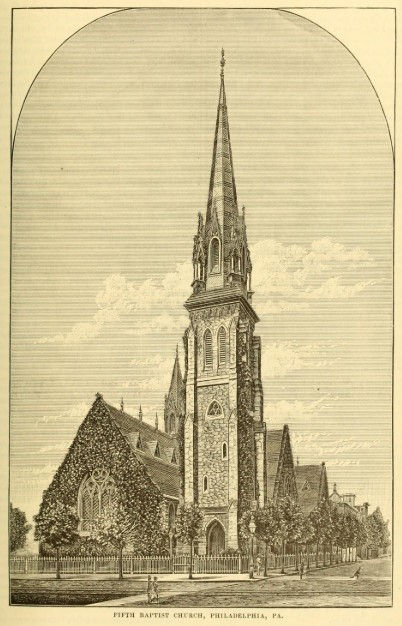
Ivy-covered Fifth Baptist Church as sketched in 1868. The source for the sketch is the 1881 Baptist Encyclopedia here. The interior was built with a traditional cruciform sanctuary with a fifty-foot ceiling supported by wood trusses.

1871 photo for the Baldwin catalog looking west on Spring Garden from Broad Street.
The two churches seen on the north side of Spring Garden Street at 18th and 20th Streets are still there. The Fifth Baptist Church on the northwest corner of 18th and Spring Garden Street (now the Philadelphia Tabernacle) is seen in the photo with scaffolding still on the tower. The church first held services in the sanctuary in 1863. Other Baldwin photos from the 1871 catalog show the church without the scaffolding, so that year must have been the year when the tower was completed.
The 1871 catalog has a detailed history of the Baldwin Locomotive Works.

1876 sketch with more contrast from the Official Guide to Philadelphia here. An ornate cupola at the center of the nave and transept crossing is just to the left of the corner tower. The cupola provided natural ventilation.
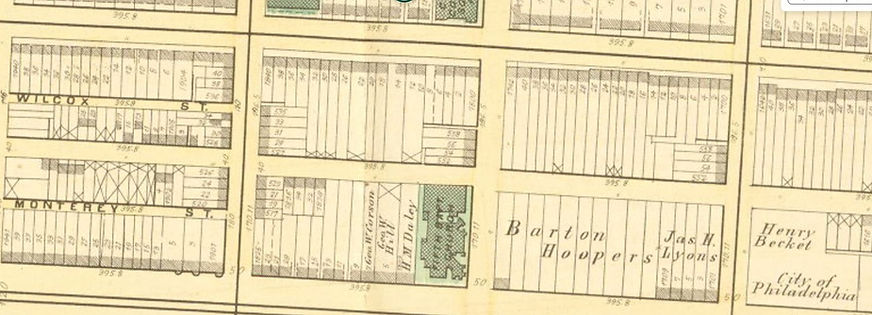
Portion of an 1875 map showing Spring Garden Street almost completely filled in except for the Barton Hoopes properties along the 1700 block. Gray hatchings represent a building. An X marks a stable. Barton Hoopes (not "Hoopers") will keep one lot for himself directly across from the church as described here. His former mansion is now the Montessori School. The property at the northeast corner of 17th and Spring Garden Streets still remains as city property and is the site of the Masterman School. A map of today would look very much the same as this map.

Description of remodel from the Philadelphia Times of October 27, 1884.
By 1884 more interior space was needed and architect Isaac Pursell converted the cruciform sanctuary into a radial plan. The semi-circular rows of pews on an inclined floor, as well as the organ discussed below. were placed at this time. A system of four main and four secondary cast iron columns were placed at this time to support the roof as interior walls were removed.

The 1884 conversion of the cruciform interior to the radial plan as envisioned by the architects who did the 1989 reconstruction as discussed in their article here (free online read with free registration).

First photo of the church circa 1908, with the pastor in inset. Pastor William Quay Rosselle replaced B. L. Whitman in 1908, so I am not sure which pastor is in the photo. Photo credit here.

Nice neighborhood: north side of the 1700 block of Spring Garden Street in 1908.
The Hoopes mansion is at the far end and the house built for chocolatier S. F Whitman is at the near end in foreground.

1924 announcement of the alterations to be done by busy starchitect Horace Trumbauer. From the Philadelphia Real Estate and Builders' Guide here. Around this same year Horace Trumbauer and his lead assistant Julian Abele were also designing the Parkway Central Library (completed 1927) and the Philadelphia Museum of Art (1928).

Excerpt from a listing of Historic Religious Properties in Philadelphia prepared by the Preservation Alliance of Greater Philadelphia here. The original architect in 1863 was Alfred Biles and the 1884 sanctuary remodel was done by architect Isaac Pursell. Julian Abele was born in 1881. The confusion probably arises from the 1924 alterations announcement.
The church was called the Brandywine Fifth Baptist Church in part to distinguish it from the Sansom Street Baptist Church building.

Portion of a 1929 Sanborn insurance map showing the built-out block.
Blue represents masonry; pink is brick; and wood is yellow. D represents residences. The church is Gothic style with random-coursed ashlar brownstone with Gothic arched windows and brownstone buttresses.
The Highway Mission Tabernacle congregation took over the building in 1955. This congregation was founded in 1894 as described in their archives here, and went through a few decades of changes in governance, affiliations, and locations. The original association was called The Cross and Crown, because the group eschewed both symbols. Growth was favored by a series of events in the second decade of the 20th century.
Billy Sunday, an evangelical preacher and former professional baseball player, was the Billy Graham of his day. He came to Philadelphia for ten weeks in the winter of 1915 at the urging of Baldwin Locomotive Works President Alba Johnson. Johnson and others funded the construction of a wood-and-tar paper tent that could hold 20,000 on the cleared future site of the Free Library. Sunday preached twice daily in this tabernacle, and more than 1.8 million turned out for his 147 sermons. And more than 44,000 found themselves inspired to walk the “Sawdust Trails” that were the aisles, confirming their faith via a handshake with Sunday. Three years later, celebrity Pentecostal evangelist Aimee McPherson built a 500-seat tent on Midvale Avenue. She returned in 1920 and had folks throwing away their crutches at 17th and York Streets. Both these visitors boosted church attendance and Pentecostalism.
There is a five-minute video here about Resurrection Life Chucrch.

The strong feelings about crosses and crowns incorporated into their logo. Baptists would rather emphasize Christ's resurrection than his sufferings on the cross. Some Baptists will display a cross, but never a crucifix. In addition, there is nothing in the New Testament about the display of crosses so they are unbiblical and therefore not utilized.
Photo credit at the Resurrection Life website here.

1986: fire at the Highway Tabernacle Assembly of God Church, as discussed in our article about neighborhood fires here.
The church has a Korean congregation as noted in the caption. The Korean-language Antioch City Church still meets in the church on Sundays at 2 pm. A sandwich-board sign placed at a side entrance during Sunday service is the only marker of this congregation. Back in the early 1900s the First Baptist Chinese Church held Sunday evening services there. Still another ethnic group used the church facilities for bible study starting in 1929. This pan-Latino protestant group moved in 1946 to its own facilities in Northern Liberties as the First Spanish Baptist Church. It is now active in a church in Kensington.

Another view of the fire damage one day after the fire of August 21, 1986.
The fire started in the attic above the ceiling of the sanctuary. There was heat and water damage to the lower sanctuary. The chapel annex was spared. Restoration was nearly complete 15 months later at a cost of $1.5 million. The church acquired new and improved electrical, plumbing, lighting, sound, insulation and heating systems. Synthetic slate was used for the roof tiles.
This photo was probably taken from a high floor of the 307-unit Museum Towers I which was then under construction and completed in 1987. It is now part of the North x Northwest Apartments complex.
The church and the parsonage property at 552 North 18th Street (just across Brandywine Street) were deeded to the Chicago Tabernacle for $1 in March of 2022. At that time the combined properties were assessed at $1.6 million. The townhome had been purchased by the Highway Tabernacle Church in 1999 for $35,000 for use as a parsonage. It was sold for $950,000 in July 2022 to a local realtor and sold again 11 months later for $1.8 million, presumably having been renovated. The 5-bedroom, 5-bath, 4,000 square foot townhome is currently for sale for $1.6 million. The history of that townhome includes the 1951 death of an occupant, 56-year-old Perfecto Rodriquez, when he was run over by a train at 19th and Market Street. His funeral arrangements were by the Dinan Funeral Home at 1923 Spring Garden Street and his funeral mass was at the Spanish Chapel of the Miraculous Medal at 1903 Spring Garden Street.

Former parsonage at 552 North 18th Street for sale as of June 2026. It has five bedrooms, six bathrooms, and 3900 square feet. It fronts Brandywine Street as far back as its two-car garage.
The current campus pastors of Philadelphia Tabernacle are the husband and wife team of Josh and Susie LeBlanc. The modifier "campus" is used because the "lead pastors" are the Chicago-based husband and wife team of Al and Chrissy Toledo. And now, a little family and church genealogy starting back in 1966:
There was a church called the Central Presbyterian Church in Brooklyn, New York, that was established in 1847. In 1966 pastor Clair D. Hutchins settled down in Brooklyn, giving up his globetrotting evangelism tours, and he renamed the church Brooklyn Gospel Tabernacle. Clair and his wife had six children, one of whom, Carol would follow in the path of pastoral care.
Carol Hutchins, Clair's daughter, grew up in the Brooklyn Tabernacle and there met her future husband Jim Cymbala. In 1971 the couple took over the church leadership. Carol founded the Brooklyn Tabernacle Choir which has grown to 270 voices and been awarded seven Grammys. Jim as lead pastor built the congregation into a 10,000-member megachurch with a sanctuary holding 3,400 members. Carol and Jim had three children, one of whom, Chrissy, would continue this story.
Al Toledo and Chrissy Cymbala grew up in Brooklyn and met through the church run by Chrissy's parents. In 2002 Al and Chrissy moved to Chicago to found Chicago Tabernacle. In 2022 they decided to open a campus in Philadelphia, sending their daughter Susie and her husband of eleven years Josh LeBlanc to be campus pastors.

Family resemblance of logos:
The Brooklyn Tabernacle of Clair and Carol Hutchins on the left;
The Chicago Tabernacle of Al and Chrissy Toledo in the middle;
and the Philadelphia Tabernacle of Josh and Susie LeBlanc on the right.

Campus pastors Josh and Susie LeBlanc, with Wesley and James (future fifth-generation pastors???), Photo credit here.
The tenets of a denomination can be difficult to parse, especially the tenets that distinguish one denomination from another. For this reason I will link to the core beliefs of the Philadelphia Tabernacle branch of the Chicago Tabernacle here instead of trying to summarize them. Both Tabernacles are part of the Assemblies of God consortium, which claims to have 3 million adherents in the United States and 88 million worldwide.
As an example of how terminology changes, let's look at the terms fundamentalism and evangelicalism, both of which could be applied to the Philadelphia Tabernacle. We need look no further than the IBEW parking lot at 1725 Spring Garden Street where congregants of the Philadelphia Tabernacle park their cars for Sunday services.
In 1918, the Bible Conference Committee purchased 1723 Spring Garden Street and then the houses on either side, including 1725 Spring Garden Street. Christian fundamentalism was on the rise in the late nineteenth century, a reaction to the trend of the historical analysis of the Bible, the popularization of science, women's demands for equal rights, and increased immigration. The Balfour Declaration of 1917 fed into the post-apocalyptic fervor of those who believed that Christ would return only after the Jewish homeland was restored. This accounted for much of the enthusiasm for the Billy Sunday and Aimee McPherson visits to Philadelphia from 1915 to 1920 mentioned above. From May 25 to June 1, 1919, a conference was held at 1723 Spring Garden Street that some mark as the birth of the American fundamentalist movement. This was organized by Minneapolis Baptist preacher William Bell Riley, who proudly embraced the term fundamentalism to describe his restoration of the Christian faith. Over 6,000 true believers made the pilgrimage to the mecca at 1721-1725 Spring Garden Street, from 42 of the 48 states, from Canada, and from seven other countries. In 1947 William Bell Riley was visited on his deathbed by a young preacher who received the torch of fundamentalism from Riley. The young preacher's name was Billy Graham, and he began calling his followers evangelicals instead of fundamentalists.
The American South is today considered the hotbed of fundamentalism, but northeastern cities, especially Philadelphia, gave the movement its first organization and political strategies. Today's free-thinking Philadelphians would be surprised to read this centennial article in the New York Times from May of 2019.
After the conference, the Philadelphia Bible Institute continued expanding, eventually owning the seven houses from 1719 through 1731. It sold all its property here in 1951.

Introductory page in the 1919 collection of speeches given at 1721-1725 Spring Garden Street to 6,000 attendees, from here. This 480-page volume is the platform of Christian fundamentalism in North America.
The church is a spectacular Gothic building with massive stone facades. The interior also has its charms. The sanctuary was the main victim of the 1986 fire and was quickly restored. The ceiling supported by cast iron arches rises 70 feet above the pews. During the restoration a sloped floor for stadium seating was placed. The chapel on the north side of the complex was divided vertically by a new floor that eliminated the soaring ceiling there, and horizontally by partitions that formed meeting rooms, child care areas, and administration offices.

Pastor Tim is seen here filling in from the Chicago Tabernacle in June of 2026.
The organ is a 1884 Roosevelt model that was refurbished in 1989 and sounds great, as this 22-minute video shows.
The Roosevelt Organ Works made high-end church organs at 317 South 22nd Street from 1880 to 1891. The company was founded in 1872 by brothers Hilborne (1849-1886) and Frank (1862-1895) Roosevelt and based in New York. Both brothers died in their mid-30s and the company ceased operation in 1893.

Commendation near the organ in the Philadelphia Tabernacle.
Fortunately this 27-rank mechanical tracker organ survived the 1986 fire.
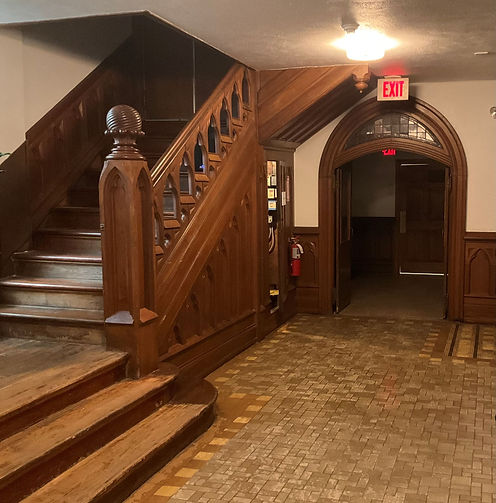
Beautiful woodwork in the entrance lobby

The Stiffel & Freeman Company made high-quality safes at 60 North 4th Street in Philadelphia from 1870 to 1920. This one has been within the church entrance almost from the church's beginnings.
